


A tree that looks fine from your porch can be quietly failing underground. That gap between what you see and what is actually happening is exactly why a tree health assessment matters, and why so many homeowners are caught off guard when a seemingly healthy tree drops a limb or topples in a storm.
If you have ever wondered whether your oak, maple, or pine is doing as well as it looks, or you noticed something off and are not sure whether it is serious, this guide will walk you through everything you need to know. You will learn what a tree health assessment actually involves, how to do a basic check yourself, when the situation calls for a certified arborist, and what separates a genuinely useful assessment from a quick glance and a guess.
What Is a Tree Health Assessment
A tree health assessment is a structured look at a tree’s condition, covering its leaves, branches, trunk, and root system, to determine whether it is thriving, struggling, or at risk of failure. It is less like a casual glance and more like a checkup, one that follows a consistent order so nothing important gets missed.
The goal is not just to notice that something looks wrong. A good assessment tries to identify why a tree is declining, whether that cause is treatable, and what should happen next. That distinction, between spotting a symptom and understanding its source, is what separates a useful evaluation from a passing observation.
Trees are living organisms that respond to stress the same way many other organisms do: slowly at first, then suddenly. A tree can carry internal decay or root damage for years while still producing a full canopy of green leaves. That is part of why regular assessment matters so much. By the time visible symptoms are dramatic, the underlying problem is often advanced.
Why Tree Health Assessment Matters More Than Most Homeowners Realize

It is tempting to assume that if a tree still has leaves, it must be fine. Unfortunately, that assumption is one of the most common and costly mistakes property owners make.
Here is why regular tree health assessment deserves a place on your home maintenance list, right alongside gutter cleaning and roof inspections.
It protects people and property. A large limb or an entire tree failing without warning can damage a roof, a car, a fence, or worse. Catching structural weakness early gives you options that disappear once a failure has already happened.
It saves money over time. Treating an early stage fungal infection or addressing soil compaction costs a fraction of what emergency tree removal costs after a failure, especially if that failure damages a structure or requires crane access.
It preserves the value a mature tree adds. Established trees increase property value and curb appeal in ways that take decades to replace. Losing one unnecessarily, because a treatable problem went unnoticed, is a loss that cannot be quickly undone.
It supports better decision making. When you understand what is actually happening with a tree, you can make an informed choice between treatment, pruning, monitoring, or removal, rather than guessing or reacting out of fear after a storm.
The Four Areas Every Tree Health Assessment Should Cover
A thorough tree health assessment moves through the tree in a logical order, from the top down or the ground up, and touches four core areas.
Crown and Canopy
The crown is often the first place trouble shows up, but it can also be the last place internal problems become visible. Arborists look at leaf color, size, and density compared to what is normal for that species and season.
Signs worth noting include thinning foliage, leaves that are smaller than usual, premature color change outside of autumn, and dead branches concentrated in one section of the canopy. A tree that is shedding leaves out of season is telling you something, even if the rest of it looks green.
Trunk and Structure
The trunk carries the weight of the entire tree, so any compromise here has outsized consequences. A proper look at the trunk checks for cracks, cavities, oozing sap, unusual swelling, and fungal growth such as conks or shelf like fungus at the base.
Pay close attention to where major branches meet the trunk. A narrow, V shaped union with bark trapped inside it, known as included bark, is one of the most commonly overlooked structural weaknesses on residential trees, and it is far more likely to fail than a rounded, U shaped union.
Root System and Soil
Roots are out of sight, which is exactly why they are so often overlooked. A large share of tree health problems begin below the surface, in soil that has become compacted, poorly drained, or disturbed by nearby construction.
Look for exposed roots, roots that circle and press against the trunk (called girdling roots), soil that has heaved or cracked near the base, and any mulch or soil piled directly against the trunk. That last one is more common, and more damaging, than most people realize.
Site and Surrounding Conditions
The environment around a tree shapes its health just as much as the tree itself. Recent grading, trenching for utilities, new pavement, changes in irrigation, or chemical treatments applied nearby can all trigger decline that has nothing to do with disease or pests.
Noting these factors during an assessment often explains symptoms that would otherwise seem mysterious. A tree that started declining after a driveway was poured last year is not a coincidence.
How to Do a Basic Tree Health Assessment Yourself
You do not need professional tools to catch the majority of visible warning signs. A homeowner walk around, done consistently, is genuinely valuable and takes less time than most people expect.
- Stand back first. From thirty to fifty feet away, look at the whole tree. Is the canopy even on all sides? Is the trunk leaning, and if so, is there any soil lifting at the base?
- Walk a full circle around the tree. Problems are often only visible from certain angles. Note any large dead branches, cracks, or unusual bark texture as you go.
- Check the leaves and canopy up close. Compare color and density to what you remember from previous years, or to a healthy tree of the same species nearby.
- Examine the trunk at eye level and near the base. Look for cracks, cavities, sap, and any fungal growth.
- Look at the ground around the root zone. Check for exposed or circling roots, soil heaving, and compacted or bare patches from foot traffic.
- Take photos every time. A wide shot, a mid range shot of the trunk, and close ups of anything unusual, all with a timestamp, make it much easier to track changes over time or share with an arborist later.
This entire process takes most homeowners under thirty minutes per tree. Doing it once or twice a year, plus after any major storm, is enough to catch the vast majority of developing problems while they are still manageable.
Warning Signs That Should Never Be Ignored
Some symptoms call for more than a note on your checklist. If you see any of the following, treat it as urgent and keep people, pets, and vehicles clear of the area until a professional has taken a look.
- A tree that is leaning and the lean is new, worsening, or paired with soil lifting at the base
- Large mushroom like fungal growths at the trunk base or root collar
- Deep cracks in the trunk that run vertically or spiral around it
- A cavity opening wider than a few inches on a tree near a home, driveway, or walkway
- Sudden failure of a large limb, even if the rest of the tree still looks healthy
- Significant, newly exposed roots combined with a thinning canopy
None of these signs guarantee the tree will fail immediately, but each one indicates a level of risk that deserves a professional opinion rather than a wait and see approach.
Tree Health Assessment by Season: What to Look for and When
Timing changes what you are likely to notice, and building a seasonal habit makes assessment far more effective than a single annual glance.
Spring, before the canopy fully fills in, is the best time to spot winter damage such as broken branches, cracked bark, and early fungal growth, since the structure is not yet hidden by leaves.
Late summer tends to reveal fungal fruiting bodies and pest activity most clearly, since warm, humid conditions favor both. Insects like borers and scale are also easier to spot on foliage during this window.
Fall is when dieback patterns and uneven leaf drop become obvious. A branch holding onto dead, brown leaves while the rest of the canopy has dropped normally is a reliable signal of a localized problem.
If you only have time for one seasonal check each year, spring is generally the most informative, since winter stress and structural damage are still visible and easy to catch early.
Tree Health Assessment vs Tree Risk Assessment
These two terms get used interchangeably, but they are not quite the same thing, and understanding the difference helps you ask for the right service.
A tree health assessment asks a biological question: is this tree alive, growing well, and free of disease or significant pest pressure? The focus is vitality.
A tree risk assessment asks a safety question: could a part of this tree fail, and what would happen if it did? This involves evaluating the likelihood of failure alongside what sits underneath the tree, whether that is a house, a road, or an empty field.
A tree can be biologically healthy and still pose a structural risk, and the reverse is also true. Many certified arborists perform both assessments together, since the findings from one often inform the other.
When to Call a Certified Arborist
A homeowner walk around catches a lot, but it has limits. Certain situations genuinely call for a trained professional with the right tools and training.
Reach out to a certified arborist if you notice any of the red flag signs listed earlier, if a tree shows gradual decline over more than one season without an obvious cause, if you are planning construction or landscaping near mature trees, or if you are buying a property with large trees on it and want to understand what you are inheriting.
Look specifically for an ISA Certified Arborist, a credential from the International Society of Arboriculture that requires passing an exam and maintaining ongoing education. For situations involving structural risk near a home or public area, ask whether the arborist also holds a Tree Risk Assessment Qualification, since that credential focuses specifically on evaluating failure potential using a standardized method.
What Happens During a Professional Assessment
Knowing what a thorough visit looks like helps you judge whether the service you receive is genuinely comprehensive or just a quick opinion.
A proper professional assessment typically starts with a conversation about your concerns and the tree’s history, followed by a systematic visual inspection from the roots to the crown. The arborist records measurements such as trunk diameter and estimated canopy dieback, and documents everything with photos.
If internal decay is suspected but not visible from the outside, some arborists use tools such as a resistograph, which measures wood density as a small drill advances through the trunk, or sonic tomography, which uses sound waves to map internal voids without cutting into the tree. These tools are not needed for every assessment, but they matter for high value trees or situations where a removal decision hinges on how much sound wood remains.
The visit should end with a clear written or verbal summary: what was found, what it likely means, and specific next steps, whether that is monitoring, treatment, pruning, or removal.
What a Tree Health Assessment Typically Costs
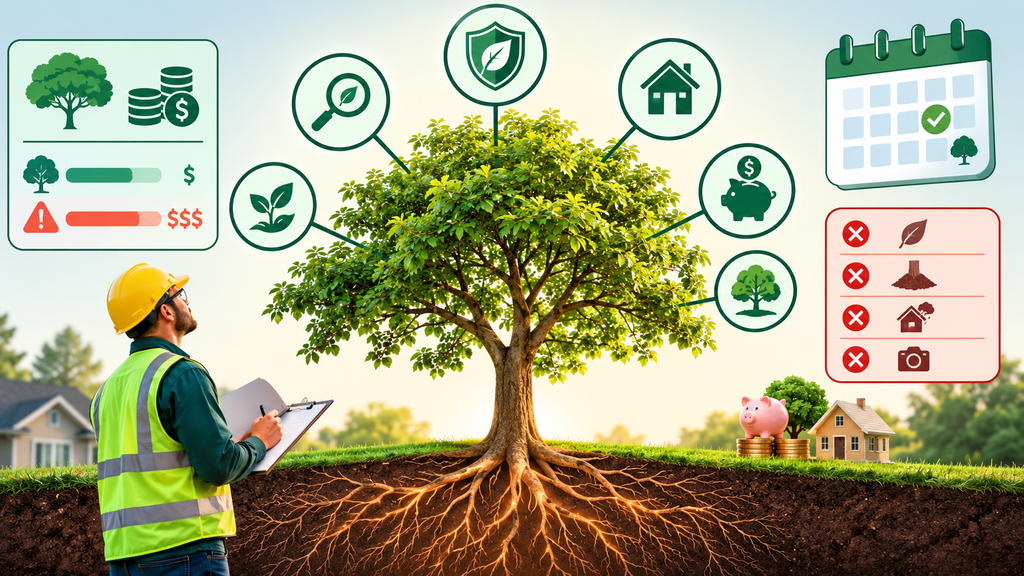
Pricing varies by region, tree size, and how many trees are being assessed, but general ranges give you a useful benchmark.
A single tree visual assessment commonly falls somewhere between seventy five and two hundred fifty dollars. A full property evaluation covering multiple trees often runs from a few hundred dollars up to eight hundred dollars or more, particularly if a written report is included.
Advanced diagnostic tools, such as resistograph testing or a formal written risk report for insurance or HOA purposes, typically add to that base cost. It is reasonable to ask for a breakdown before scheduling, so you know exactly what is included.
Compared to the cost of emergency tree removal after a failure, which frequently runs into the thousands of dollars once property damage is involved, a routine assessment is one of the more affordable pieces of home maintenance you can budget for.
How Often You Should Assess Your Trees
For most established, healthy trees, an annual walk around is a solid baseline, paired with a professional visit every one to three years.
Trees positioned close to a home, a driveway, or a high traffic area deserve more frequent attention, ideally an annual professional check, given the higher consequences if something goes wrong. Any tree that experienced visible stress during a storm, drought, or nearby construction should be reassessed sooner rather than waiting for the next scheduled check.
Newly planted trees are the exception in the other direction. Check on those monthly during their first growing season, then quarterly for the following two to three years while their root systems establish.
Common Mistakes Homeowners Make
A few patterns show up again and again, and avoiding them will make your assessments far more effective.
Assuming green leaves mean a healthy tree. Internal decay and root problems can exist for years behind a full, green canopy.
Piling mulch against the trunk. This traps moisture against the bark, encourages rot, and buries the root flare in a way that mimics the symptoms of a much more serious problem.
Waiting until there is obvious damage. By the time a problem is visible from the street, it has often been developing for a long time, and your options have narrowed considerably.
Skipping documentation. Without photos from previous checks, it is genuinely difficult to know whether a tree has changed, or by how much, over the past year.
Conclusion
A tree health assessment is not a one time task, it is an ongoing habit that pays for itself many times over. Learning to spot the early signs of decline, from thinning foliage to trunk cracks to soil disturbance around the roots, puts you in a position to act while treatment and pruning are still realistic options rather than waiting until removal is the only one left.
Combine a simple seasonal walk around with a professional check every one to three years, and take red flags such as new leaning, large cavities, or fungal growth at the base seriously enough to call a certified arborist right away. That balance of regular attention and timely professional input is what protects both your trees and everything around them.
Frequently Asked Questions
How do I know if my tree needs a professional assessment or if I can just monitor it myself?
Minor issues like a few dead twigs or slightly early leaf drop can usually be monitored at home. Anything involving a new lean, large cracks, fungal growth at the base, or significant root exposure warrants a professional opinion.
Can a declining tree actually recover?
Often, yes, especially if the cause is caught early and is something treatable, such as soil compaction, nutrient deficiency, or a contained pest issue. Trees with extensive internal decay or widespread root failure are much harder to save.
Is it normal for a tree to lose some leaves early in the season?
Occasional early leaf drop from heat or a dry spell can be normal, but repeated early drop across multiple seasons, or drop concentrated in one section of the canopy, usually points to an underlying stress worth investigating.
Does a healthy looking tree still need a risk assessment?
Yes. A tree can be biologically healthy while still carrying a structural defect, such as a weak branch union or hidden internal decay, that makes it a safety risk. Health and structural risk are related but separate questions.
How long does a professional tree health assessment usually take?
A single tree visual assessment typically takes fifteen to thirty minutes. A full property evaluation with multiple trees, measurements, and a written report can take one to several hours depending on the number and size of the trees involved.
