

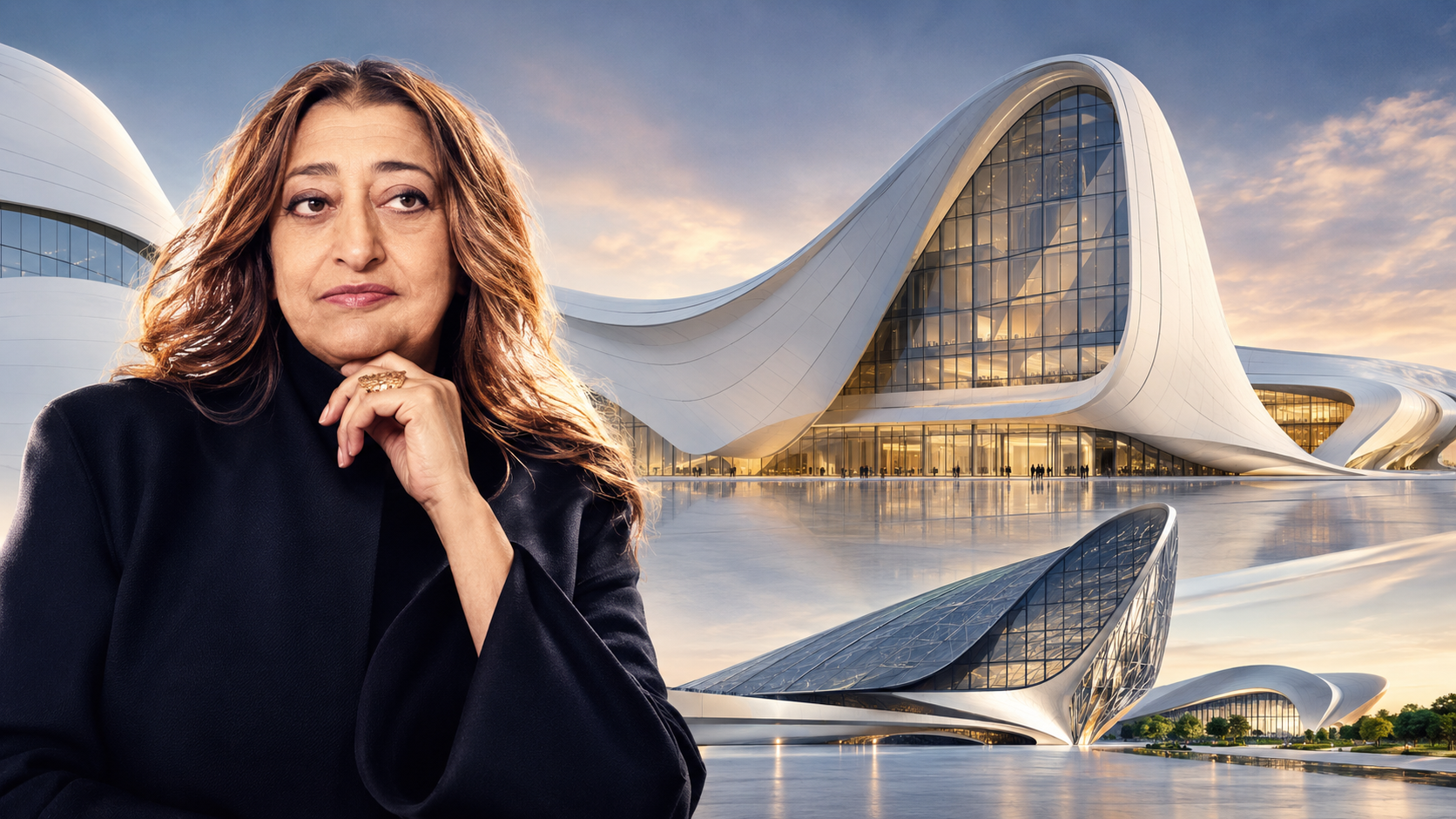
Who Was Zaha Hadid
Zaha Hadid was an Iraqi born British architect whose flowing, futuristic buildings changed how the world thinks about space, structure, and possibility. She became the first woman to win the Pritzker Architecture Prize, often called the Nobel Prize of architecture, and her work continues to influence designers, engineers, and city planners across the globe.
Ask most people to picture a Zaha Hadid building and they will describe something that looks less like a structure and more like a wave frozen in motion. That instinct is correct. Her buildings rarely have straight edges or predictable corners. They curve, twist, and seem to defy gravity, which is exactly why she earned the nickname Queen of the Curve.
This article looks beyond the basic facts you might already know. It explores her personal journey, the ideas behind her most famous works, the obstacles she overcame, and the lasting impact she left on architecture and design.
Early Life and the Roots of a Visionary
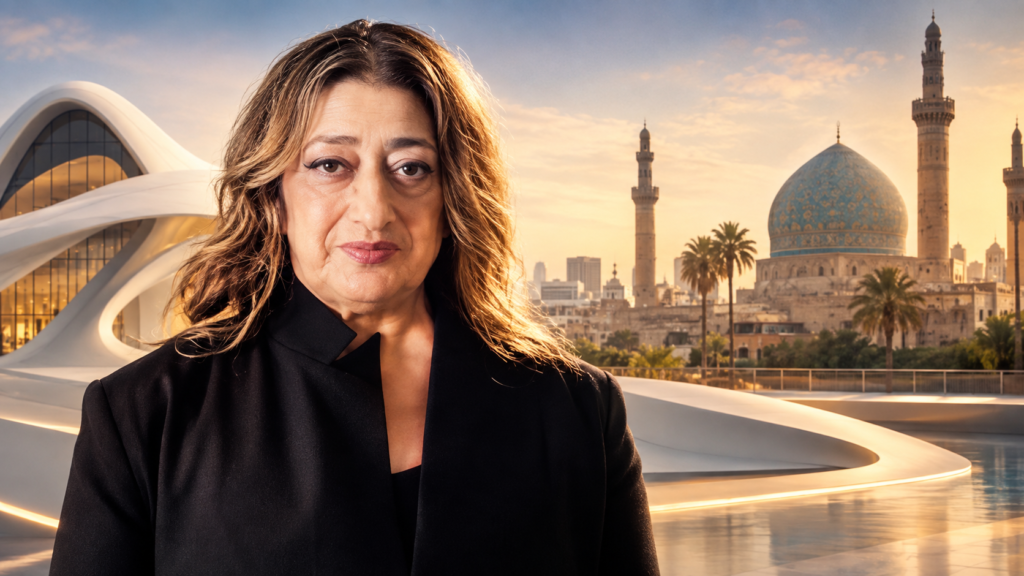
Zaha Hadid was born on October 31, 1950, in Baghdad, Iraq, into a progressive and well educated family. Her father was a businessman and politician who co founded a democratic political party in Iraq, and her mother was an artist. That combination of pragmatic ambition and creative expression shaped the household Hadid grew up in.
As a child, she attended a Catholic school in Baghdad alongside students of different faiths and backgrounds, an early exposure to diversity that stayed with her throughout her career. Her family later sent her to boarding schools in Switzerland and England, giving her a truly international upbringing before she had even chosen a profession.
Baghdad itself played a quiet but important role in her creative development. The city’s mix of ancient Islamic architecture and mid century modernist buildings, many designed by international architects invited to the region, gave young Hadid an early visual vocabulary that blended tradition with innovation.
From Mathematics to Architecture
Before she ever sketched a building, Hadid studied mathematics at the American University of Beirut. This detail matters more than it might seem. Mathematics trained her to think in systems, geometry, and logic long before she applied those skills to physical space.
In 1972, she moved to London to study at the Architectural Association School of Architecture, one of the most progressive architecture schools in the world at the time. There she studied under Rem Koolhaas and Elia Zenghelis, two influential figures who would later become her professional collaborators.
Her graduation project, a design inspired by the Russian avant garde artist Kazimir Malevich, immediately signaled that she was not interested in conventional architecture. It was bold, abstract, and unlike anything her classmates were producing.
Working at OMA
After graduating in 1977, Hadid joined the Office for Metropolitan Architecture, the firm founded by Koolhaas, where she worked as a partner. This period sharpened her design instincts and gave her real world experience with large scale projects, even though she was still years away from building her own designs.
The Long Road to Recognition
Here is something that rarely gets enough attention in articles about Zaha Hadid: for nearly two decades, she was mostly known as a paper architect. This term describes designers whose work exists primarily in drawings, models, and competition entries rather than finished buildings.
Hadid founded her own firm, Zaha Hadid Architects, in 1979. Yet many of her early winning competition designs were never built. Clients and construction teams often considered her ideas too radical, too expensive, or simply too difficult to engineer with the technology available at the time.
This is a crucial part of her story. Success did not come quickly or easily. She spent years refining ideas that the industry was not yet ready to execute, all while facing skepticism about whether her designs could be built at all.
The turning point came gradually as computer aided design and advanced engineering software matured in the 1990s and early 2000s. Suddenly, the curved, complex geometries she had been sketching for years became structurally and financially feasible.
Founding Zaha Hadid Architects
Once technology caught up with her imagination, Zaha Hadid Architects grew rapidly. What started as a small practice with a handful of employees eventually expanded into an international firm with hundreds of architects, engineers, and designers working on projects across dozens of countries.
The firm became known not just for striking aesthetics but for technical ambition. Projects often required custom software, experimental materials, and close collaboration with structural engineers to bring Hadid’s vision to life without compromising safety or function.
A Culture of Constant Experimentation
Inside the studio, Hadid pushed her team to treat every project as an opportunity to solve a new spatial problem rather than repeat a formula. This is part of why her portfolio, spanning museums, transit stations, stadiums, bridges, and residential towers, feels remarkably varied while still carrying a recognizable signature style.
The Design Philosophy That Changed Architecture
Zaha Hadid is closely associated with two major movements in architecture: deconstructivism and later parametricism.
Deconstructivism, which defined much of her early career, rejects the idea that buildings must follow rigid, predictable geometric rules. Instead, it embraces fragmentation, asymmetry, and forms that appear to be in motion or mid transformation.
Later in her career, Hadid became a leading voice in parametricism, a design approach that uses algorithms and computational tools to generate complex, organic forms based on variables like light, movement, and structural stress. Rather than drawing a shape and forcing it to work, parametric design lets data and mathematical relationships shape the final structure.
In practical terms, this means her buildings often respond to their environment in ways traditional architecture does not. A roofline might curve to guide airflow, or a facade might shift its pattern based on how sunlight moves across it throughout the day.
She once explained that she believed imaginative architecture could genuinely improve people’s lives, not just look impressive in photographs. That belief shaped every project she touched, from small furniture pieces to entire transit systems.
Iconic Buildings That Define Her Legacy
While Hadid designed dozens of notable projects, a handful stand out as career defining achievements.
Heydar Aliyev Center, Baku, Azerbaijan This cultural center is perhaps her most photographed building. Its flowing white exterior appears to melt into the ground, eliminating any clear distinction between walls, roof, and floor. It remains one of the clearest examples of her ability to make concrete and steel feel fluid.
London Aquatics Centre, United Kingdom Built for the 2012 London Olympics, this venue features a wave inspired roof that has become one of the most recognizable sports facilities in the world. It balances dramatic visual impact with the practical demands of hosting international competitions.
MAXXI Museum, Rome, Italy This museum of contemporary art and architecture demonstrates her skill at using interior space as a design element in itself. Visitors move through curving corridors that feel more like a journey than a simple walk between galleries.
Guangzhou Opera House, China Often compared to two river stones shaped by water, this opera house shows how Hadid drew inspiration from natural landscapes and translated that into monumental public architecture.
Vitra Fire Station, Germany One of her first major built projects, completed in 1993, this early work already displayed the sharp angles and dynamic energy that would define her later, more fluid designs.
Together, these buildings illustrate a career that evolved from angular, fragmented forms toward the smooth, continuous curves most people associate with her name today.
Breaking Barriers as a Woman in Architecture
Architecture has historically been a male dominated profession, and Hadid faced that reality throughout her career. She was frequently the only woman in the room during competition juries, client meetings, and construction site visits.
Rather than downplay this challenge, Hadid addressed it directly in interviews, often noting that she refused to make her work smaller or safer just to fit expectations. She wanted her buildings judged on their own merit, not filtered through assumptions about what a woman architect should design.
Her 2004 Pritzker Prize win was historic precisely because no woman had received the award in its 26 year history at that point. That milestone opened doors for a new generation of women pursuing architecture, engineering, and design leadership roles.
Awards and Milestones
Beyond the Pritzker Prize, Hadid collected an impressive list of honors throughout her career, including:
- The Stirling Prize, awarded by the Royal Institute of British Architects, which she won twice
- Appointment as a Dame Commander of the Order of the British Empire in 2012
- The Royal Gold Medal from the Royal Institute of British Architects in 2016, becoming the first woman to receive it individually
- Multiple honorary professorships at institutions including Harvard, Yale, and Columbia University
These recognitions reflect not just her design talent but her influence on architectural education and theory, as she spent years teaching and mentoring the next generation of architects alongside running her firm.
Controversies and Criticism
A complete picture of Zaha Hadid includes the criticism she faced, which is often left out of shorter biographical articles.
Some of her large scale international projects drew scrutiny over labor conditions at construction sites, particularly related to stadium projects in the Middle East. Hadid publicly defended her role as the designer rather than the employer overseeing on site labor practices, a distinction that sparked ongoing debate about architects’ responsibility for how their projects are built.
Her work also faced technical criticism at times. Structural engineers occasionally questioned whether the ambitious curves and cantilevers in her designs were the most efficient use of materials and budget compared to more conventional approaches. Supporters countered that innovation always carries higher upfront costs before it becomes standard practice.
These debates do not diminish her achievements, but they add important context to understanding the full scope of her career and the industry conversations her work generated.
Beyond Buildings: Furniture, Art, and Product Design
Many articles focus exclusively on Hadid’s architecture, overlooking a significant part of her creative output. She also designed furniture, jewelry, shoes, and even a car concept, applying the same fluid, sculptural language to smaller scale objects.
Her furniture pieces, often produced in limited runs, sell as design collectibles today and appear in museum collections. This diversification demonstrated that her design philosophy was not limited to large budgets or architectural scale. The same principles of movement, geometry, and organic form applied equally to a chair or a lighting fixture.
This broader body of work also reveals how she approached design as a unified language rather than separate disciplines. Whether she was designing a museum or a handbag, the underlying logic of fluidity and dynamic form remained consistent.
Her Death and the Firm’s Legacy Today
Zaha Hadid died on March 31, 2016, in Miami, Florida, following a heart attack while being treated for bronchitis. She was 65 years old. Her death came as a shock to the architecture world, as she was still actively leading major projects at the time, including the Daxing International Airport in Beijing and the Al Wakrah Stadium in Qatar.
After her passing, longtime partner Patrik Schumacher took over leadership of the firm. In recent years, the practice has continued operating under licensing arrangements tied to the Zaha Hadid Foundation, which preserves her archive, hosts exhibitions, and supports architecture education in her name.
The firm has also expanded into new territory since her death, exploring artificial intelligence in design processes and even producing conceptual work for virtual and metaverse spaces, showing that her studio’s culture of experimentation continues even without her direct involvement.
Why Zaha Hadid Still Matters

More than a decade after her death, Zaha Hadid’s influence remains visible in skylines around the world. Architecture students still study her early competition drawings as examples of pushing creative boundaries before technology can fully support them.
Her career also offers a broader lesson that extends beyond architecture. She spent years being told her ideas were impossible to build, yet she kept refining them until the world caught up. That persistence, combined with genuine technical innovation, is what separates her from architects who are simply known for unusual looking buildings.
For aspiring architects, designers, and creative professionals in any field, her story is a reminder that groundbreaking work often looks unrealistic before it becomes iconic.
Frequently Asked Questions
What is Zaha Hadid best known for?
She is best known for pioneering a fluid, curved architectural style associated with deconstructivism and parametricism, along with becoming the first woman to win the Pritzker Architecture Prize in 2004.
What was Zaha Hadid’s nationality?
She was born in Baghdad, Iraq, and later became a British citizen after moving to London to study and practice architecture, making her both Iraqi and British by background.
What are Zaha Hadid’s most famous buildings?
Some of her most recognized works include the Heydar Aliyev Center in Azerbaijan, the London Aquatics Centre, the MAXXI Museum in Rome, and the Guangzhou Opera House in China.
How did Zaha Hadid die?
She died on March 31, 2016, in Miami, Florida, after suffering a heart attack while receiving treatment for bronchitis. She was 65 years old at the time.
Who runs Zaha Hadid’s firm today?
Following her death, longtime partner Patrik Schumacher took over leadership of the practice, which continues to operate internationally while maintaining ties to the Zaha Hadid Foundation.
Final Thoughts
Zaha Hadid’s career proves that architecture can be both deeply mathematical and profoundly emotional at the same time. She spent years being dismissed as impractical before finally seeing her boldest ideas take physical form, and that persistence reshaped what buildings are allowed to look like.
Her legacy is not just a collection of striking photographs. It is a lasting shift in how architects, engineers, and even furniture designers approach the relationship between form, technology, and human experience. Anyone studying modern design will inevitably encounter her influence, whether they are aware of it or not.
